KARLBARTOS.COM

 AudioVision, Rockhal, Luxembourg, 10.11.2006
HOME NEWS LIVE MUSIC MULTIMEDIA BAND COMMUNITY GUESTBOOK NETWORK SHOP CONTACT IMPRINT
DATE
Get latest news via RSS newsfeed

27th March 2009

Interview Karl Bartos, Galerie der Gegenwart, January 2009

Hamburg. A cold, clear day in January. Karl Bartos enters the café of the Galerie der Gegenwart. Somewhat in a rush he steers through the room straight towards our table, orders a double espresso, a carbonated water and after a few friendly introductory words we can begin. Camera: close-up Karl. Sound: restaurant noises, no background music, Karl’s Rheinian dialect meets our Viennese German.

Interview by Eva Fischer and Romana Kleewein.
THE MESSAGE
(Für die deutsche Version bitte nach unten scrollen)


sound:frame: What does audio-vision mean to you? How has it developed for you and how do you work with it?

Karl Bartos: (thinks for a long time) Unwittingly and without talking about it, we already did audio-visual performances in the sixties. When I look at photos from back then, there were already a few flickering TVs piled up in the middle of the stage! That was the big thing back then: multimedia show. In the USA Andy Warhol, Velvet Underground and the West Coast bands like Jefferson Airplane or Grateful Dead experimented with light and film. In England Pink Floyd worked on their light show. It was the time of liquids and slide projections. For us in Düsseldorf TVs worked well on stage, because interferences didn’t just look good but also – if you wanted them to – produced sounds. That’s how we started working with the waste products of the media – rather intuitively. I remember one performance where a ballet ensemble and we musicians were standing around a television tower dancing. Such a happening was euphoric and completely naive.

Sound:frame: Did you also work with film at this time?

Karl Bartos: I mean yes – there was this early experiment: We filmed our performances and projected the film onto the wall, set ourselves up in front of it and improvised with our recording. Of course we left pauses in the recording to allow for reactions. We thought we were pretty clever. Cameras were still pretty expensive, but of course there were always a few Super 8 specialists that would – if you were on their good side – record our concerts. Compared to today’s digital media it was rather tedious, because films had to be developed and cut.

Sound:frame: How did you spend the MTV-free seventies?

Karl Bartos: When I joined up with KW in 1975 I found an already existing visual identity. Looking at the record covers, a proximity to the visual arts was evident. Also, the stage design resembled an audio-visual installation. Everything was dipped into neon light and looked extremely artificial. And then there were our names Ralf, Karl, Wolfgang and Florian being fadet in as neon characters at dramaturgical points, every time causing frenetic applause. Even at my first concerts with the band we had slide projections, which were later replaced by video projections. In the eighties every musician had his own projection area behind him, which looked very symmetrical. The video loops, which couldn’t yet be synchronized, were either abstract or objective and always adjusted to the music. Interestingly, neon light was later thematized in a song on the album „The Man Machine“.

Sound:frame: Yes, I saw the clip „Neon Lights“ once. It was reminiscent of the productions of UFA.

Karl Bartos: The UFA films were a big influence, that’s true. Like the others, I was involved in the music films that were made to our songs as an actor. The direction was mainly done by my former colleague Ralf. By the way, some of our clips were played on MTV in the eighties and nineties and rose to a sort of cult status. When I was offered a guest professorship at the Berlin University of Arts, the articles of Walter Murch…

Sound:frame: …who was responsible for film editing and sound design in Coppola’s „Apocalypse Now“ and first used Surround Sound, so 5.1…

Karl Bartos: …yes, him! ...I engaged with him.

Sound:frame: When was that?

Karl Bartos: In 2003 I was first asked to co-develop the course Sound Studies. One year later, when I’d completed the album “Communication“, I was ready to start. To define my teaching in the area “Auditory Media Design“, I thought about what music – pop music in particular – would develop into. Since the end of the nineties, the music industry had collapsed after a rapid sell-out and thousands of jobs had disappeared. I don’t even want to get into the reasons much further, but obviously creativity and intelligence were not as present anymore as in the sixties, seventies and still in the eighties. Meanwhile they’re somewhere completely different, namely in the film industry, the electronic media and in the arts. So I studied everything related to film sound, read interviews, articles, presentations and books by Walter Murch, Michael Chion, Claudia Gorbman, Barbara Flückiger and others. The classification of the various sound layers – diagetic, non-diagetic, subjectively internal/external, onscreen, offscreen, ambience, acousmetre etc. – opened a new perspective for me. In short: I discovered the convergence of image and sound. For the first time in a conscious way.

Sound:frame: So you also had a theoretical approach?

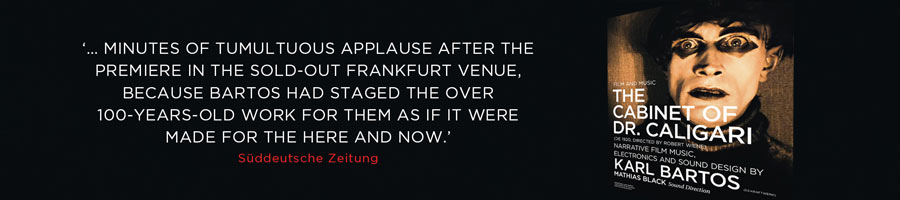
Karl Bartos: Yes, actually. I knew it was going to go towards music and media. During my time with KW I’d been interested in German film. Fritz Lang’s „M“ or „Metropolis“, Walter Ruttmann’s „Berlin – Symphony Of A Great City“ or Robert Wiener’s „The Cabinet of Dr. Caligari“ were as much classics to me as the films of Luis Buñuel and Jean Cocteau. But it’s only now that I’m really engaging with them. Through my research – it couldn’t have happened any other way – I rediscovered Bauhaus, where artists like Paul Klee and Wassily Kandinsky connected their images with elements of music, or where Ludwig Hirschfeld-Mack worked on his “Reflektorische Farblichtspiele”. They then led me to Hans Richter, Walther Ruttmann, Viking Eggeling, Oskar Fischinger. And at some stage the terms “absolute film” and “visual-musician” popped up and they began to fascinate me. And “visual-musician” is what I see myself as today.

Sound:frame: How do you approach your work as a visual-musician on a technical level?

Karl Bartos: Well, that path was a little longer! In 1999 my partner Mathias Black and I began to create an audio-visual program and I bought myself a digital camera, three video recorders und a small Panasonic mixing board. On top of that there were a whole bunch of used TVs, cables, switches and adapters – a lot of junk. We named the group “AudioVision” – after the title of Michael Chion’s book, by the way. Karsten Binar, then the art director at DMC (Design for Media and Communication), helped me create the first visual base loops. He brought the professional knowhow that I lacked: he recorded the motives, edited them and copied them to DV tapes. I then ripped that stuff to VHS tapes. In the end there were more than 100 tapes. And then all the backup copies… Quite an effort, this kind of production! (laughs). Of course I had to create a score for the complete 90 minute set, so that the whole visual direction worked. At this stage I treated the video loops basically like an instrument or, more accurately, like a chord structure. The verse had its own visual loop, just like the chorus or the middle section. I used this pattern for many songs. That’s how I could communicate the structure quite well despite the initial line-up changes. During the performance, these sources – three VHS recorders, a laptop with FinalCut and a live camera - were mixed in real time. The visual direction required one hell of a concentration, because the videotapes were switched during the songs. Later we switched to the program “Modul8” which simplified the complete workflow.

Sound:frame: And how do you work today?

Karl Bartos: We work with completely edited films that are synchronized to the music, with improvised sequences and with camera recordings. If it’s possible, we project onto three screens with either three of the same or three interchangeable sources. However, during this show I’m just a musician, while my colleague Robert Baumanns deals with the visual direction. It’s different with the live cinema concept: Here I perform the visuals myself, improvise a lot, let myself be taken and maybe even take a risk, so that it doesn’t quite work out like planned. Then I tend to concentrate more on the rhythm of the music and try to bring the rhythm and the images into unison. In this case that means much more to me than content of the message. Then I have Legér’s “Ballet Mechanic” and Fischinger’s “Murratti Gets In The Act” in my head. (laughs) Often this kind of performance is described as “visual music” or “optical jazz”.

Sound:frame: Does the visual layer influence the way you compose music?

Karl Bartos: Of course. For the new material from my workshop it’s important to me to immediately create a visual layer, to attach beat strokes with images, to not just think in musical structures. At the moment I’m trying to create rhythmic, audiovisual patterns, where it is clear though, that visual loops work differently to auditive ones.

Sound:frame: What do you mean by that?

Karl Bartos: One feels a beat that is played or programmed well as something that flows. This is known as swing or groove. It divides time and gives it a purpose. A film sequence that is edited to the same time signature is rather boring. Here the constant fulfilment of the expected is not particularly clever.

Sound:frame: Okay, I understand what you mean. Karl, how do you view the international VJ scene? Can you predict how it will develop throughout Europe or internationally?

Karl: I read every now and then that not much has changed in the past few years. At least in the last two, three years there hasn’t been a major leap. One shouldn’t forget however, that the early works of Richter, Ruttmann, Fischinger or Len Ley were so innovative, that they still seem modern, even timeless today. Don’t you think? Even in the sixties…

Sound:frame: …the liquids?

Karl Bartos: Exactly. There are a few young colleagues today, who work with liquids. They build complicated sets with cameras and mirrors and it’s quite amazing what it all amounts to. But to be honest, I don’t have access to a particular scene – I’m more of an outsider.

Sound:frame: Well, the theme of sound:frame 2009 is “EVOLUTION REMIXED!” It’s about the evolution since the 1920’s but also about the topic remix, which, through the work of FoundFootage, symbolizes an important strategy within improvisation.

Karl Bartos: FoundFootage, Remix, Mashup… I’m asking myself whether the remix hasn’t already become the original today. Everything is reversible. Actually I’m quite used to spending quite a while on a record – that’s an old-fashioned way of describing a sound recording –, in the meantime also in an audio-visual way, like, for example, an author writes a book. Part of that is research, the pilot study, the scrapping of ideas, basically different stages of development. Many colleagues don’t do it in this way anymore. We have a culture with different quality criteria. The product is defined differently, the artist statement consists more of using a particular software or plugin and the preliminary result is already good enough. Occasionally this is appropriate, because the concept is often the actual achievement. How do you work, Eva?

Sound:frame: I constantly remix, but we also produce ourselves…

Karl Bartos: It’s true: FoundFootage can be used really well. But careful! Lately it’s all been a matter of establishing a unique visual identity. It becomes clear quite quickly, whether an artist finds his own voice, is authentic or, whether he’s led to use cool footage just because it’s cheap. Who can resist that… Sometimes I think we live in a great “mashup-recycling-remix-matrix”. Isn’t there something missing when you just produce products from other products? Influences are important, but we should use them in the forms of expression of our own identity.

Sound:frame: Do you work with installations?

Karl Bartos: At the moment I’m doing an exhibition entitled “Techscapes” with the photographer and film artist Jürgen Scriba at the Deutsches Museum in Munich. He photographed machines in the museum and I composed a soundscape for it: a sound installation that highlights the technical visualizations through random acoustic listening experiences. The sound material is from processing machines, electric tools and robots. This constantly changing sound backdrop creates an interaction with the perception of the images. Yes, sound installations cause the hearing to be conscious. As a musician you primarily pay attention to your technique and expression. You concentrate on the lyric, work on the interpretation and the articulation. The performance takes center stage. An installation however, allows for a new perspective of listening. It’s an art form that is gaining more and more importance. By the way, as a musician you have a hard time. The sound artists arrange it among themselves… and with Brian Eno. (laughs) For example, if you fly to the Balearic Islands there’s guaranteed to already be a Brian Eno installation there. He was already there before you! (laughs)

Sound:frame: What do you think a performance or an installation must be able to give to the audience?

Karl Bartos: Oh God, no idea. Everyone hears sound differently… I have a very simple, not at all intellectual answer: It shouldn’t bore me! I suspect that in order for the experience of listening to not be influenced by citations, sound artists avoid musical motifs or the timbre of ordinary instruments. Now that leads me to ask whether it isn’t possible to work with musical structures.

Sound:frame: All right, but how?

Karl Bartos: I’m planning a new installation, which will be exactly about that. However, I’m not allowed to reveal any of that yet.

Sound:frame: Does video or audio stand in the foreground for you?

Karl Bartos: I can’t separate that anymore. I’m simply a visual-musician.

Sound:frame: Do you believe that perception and mood among the audience have changed in relation to the setup? Back in the day it was TV-towers, today it’s ten beamers and five screens. Do you think that the audience has come to need this?

Karl Bartos: I don’t know that. In my opinion, you can’t imagine a big club without visuals. Visual candy is quite nice, but it gets boring pretty quickly. You only need to watch for about five minutes to know whether you should stay or go home and read a book.

Sound:frame: Or you stay because you like the music…

Karl Bartos: …and close your eyes to watch your own film, like Karlheinz Stockhausen suggested.

Sound:frame: What do you want to achieve in the near future?

Karl Bartos: We are working on a big new live show and I’m not sure yet, whether we’re going to be able to create the 90 minutes of audio-visual this year anymore. We do have the concept of the triptychon, of three projectors and screens. My dream would be to rehearse a performance for weeks, like in the theater. But well…

Sound:frame: One last question: What do live shows mean to you?

Karl Bartos: Like our audience, we’re at the same place at the same time to experience the moment together. But that also means that the moment is irreplaceable. If it was good, we’ll remember it. That means a lot to me, because through that it becomes clear how transient music is. Only a few beats – just like our life.


***


EIN BILDMUSIKER IN WIEN

INTERVIEW KARL BARTOS, GALERIE DER GEGENWART, HAMBURG, JANUAR 2009

Hamburg. Ein kalter, klarer Tag im Januar. Karl Bartos betritt das Café der Galerie der Gegenwart. Etwas in Eile steuert er quer durch den Raum auf unseren Tisch zu, bestellt einen doppelten Espresso, ein Wasser mit Kohlensäure, und nach ein paar freundlichen, einleitenden Worten geht’s los. Kamera: Close-up Karl. Sound: Restaurantgeräusche, keine Hintergrundmusik – Karls rheinischer Dialekt trifft auf unser Wiener-Deutsch.

Das Interview führten Eva Fischer und Romana Kleewein.


sound:frame: Was bedeutet Audiovision für Dich, wie hat sich das für Dich entwickelt, und wie arbeitest Du damit?

Karl Bartos: (denkt lange nach) Unbewusst haben wir schon in den 60er Jahren audiovisuelle Performances gemacht, ohne darüber zu sprechen. Wenn ich Fotos von früher anschaue, waren da schon mal ein paar Fernseher in der Mitte der Bühne aufeinander getürmt, die flimmerten! Das war damals das große Ding: Multimedia-Show. In den USA experimentierten Andy Warhol, Velvet Underground und die Bands der West Coast wie Jefferson Airplane oder Greatful Dead mit Licht und Film; in England arbeiteten Pink Floyd an ihrer Lightshow. Es war die große Zeit der Liquids und Diaprojektionen. Für uns in Düsseldorf funktionierten jedenfalls Fernseher auf der Bühne, denn Bildstörungen sahen nicht nur gut aus, sondern produzierten – wenn man wollte – auch noch Klänge. So fingen wir an, mit den Abfallprodukten der Medien zu arbeiten – eher intuitiv. Ich erinnere mich an eine Aufführung, bei der wir Musiker und eine Ballettgruppe um einen Fernsehturm standen oder tanzten. So ein Happening, es war euphorisch und komplett naiv.

sound:frame: Habt Ihr in dieser Zeit auch mit Film gearbeitet?

Karl Bartos: Ich meine ja – da war dieses frühe Experiment: Wir filmten eine unserer Performances und projizierten später den Film an die Wand, bauten uns davor auf und improvisierten mit unserer Aufnahme. Natürlich hatten wir bei der Aufzeichnung entsprechende Pausen gelassen, um Reaktionen zuzulassen. Wir kamen uns dabei ganz schön clever vor. Kameras waren noch sehr teuer, aber es gab natürlich immer einige Super 8-Spezialisten, die – wenn man sich gut mit ihnen stellte – unsere Konzerte aufnahmen. Mit den heutigen digitalen Medien verglichen war es eher mühevoll. Denn die Filme mussten natürlich erst entwickelt und geschnitten werden.

sound:frame: Wie hast Du die noch MTV-freien 70er Jahre verbracht?

Karl Bartos: Als ich 1975 zur Gruppe KW stieß, fand ich dort bereits eine eigene visuelle Identität vor. Den Plattencovern der Band war anzusehen, dass hier eine Nähe zur Bildenden Kunst bestand, und auch das Bühnenbild glich einer audiovisuellen Installation. Alles wurde in farbiges Neonlicht getaucht und sah extrem künstlich aus. Und da waren noch unsere Namen Ralf, Karl, Wolfgang und Florian als Neonschriftzeichen, die immer an einer dramaturgisch passenden Stelle eingeschaltet wurden und jedesmal einen frenetischen Applaus hervorriefen. Schon bei meinen ersten Konzerten mit der Band hatten wir Diaprojektionen, die später durch Videoprojektionen ersetzt wurden. In den 80er Jahren hatte schließlich jeder Musiker eine eigene Projektionsfläche hinter sich, was sehr symmetrisch aussah. Die Videoloops, die noch nicht synchron abgespielt werden konnten, waren entweder abstrakt oder gegenständlich und natürlich immer auf die Musik abgestimmt. Interessanterweise wurde Neonlicht später auf dem Album „Die Mensch Maschine“ in einem Song thematisiert.

sound:frame: Ja, den Clip „Neonlicht“ habe ich mal gesehen. Er erinnerte etwas an die Produktionen der UFA.

Karl Bartos: Die UFA-Filme waren schon ein großes Vorbild, das ist wahr. An den Musikfilmen, die zu unseren Songs gedreht wurden, habe ich als Darsteller mitgewirkt wie die anderen auch. Die Regie hat meistens mein früherer Kollege Ralf geführt. Übrigens wurden einige Clips in den 80er und 90er Jahren bei MTV gesendet und erhielten einen gewissen Kultstatus. Als mir dann später eine Gastprofessur an der Universität der Künste Berlin angeboten wurde, habe mich intensiv mit den Artikeln von Walter Murch...

sound:frame: ...der bei Coppolas „Apocalypse Now“ für Film Editing und Sound Design verantwortlich war und das erste Mal Surround Sound, also 5.1, verwendete...

Karl Bartos: ...ja, der! ...auseinander gesetzt.

sound:frame: Wann war das?

Karl Bartos: 2003 bin ich das erste Mal gefragt worden, den Studiengang Sound Studies mit zu entwickeln. Ein Jahr später, als ich mein Album „Communication“ fertig hatte, konnte es losgehen. Um meine Lehre in meinem Fachbereich der „Auditiven Mediengestaltung“ zu definieren, machte ich mir zunächst darüber Gedanken, wohin sich die Musik – vor allen Dingen die Popmusik – entwickeln würde. Die Musikindustrie war seit dem Ende der 90er Jahre nach einem rasanten Ausverkauf in sich zusammengebrochen und tausende Jobs waren verschwunden. Ich will jetzt gar nicht auf die Gründe näher eingehen, aber offensichtlich war Kreativität und Intelligenz in der Popmusik nicht mehr zu finden so wie in den 60er, 70er und auch noch in den 80er Jahren. Mittlerweile sind sie ganz woanders und zwar dort, wo es eine Wertschöpfung gibt, nämlich in der Filmindustrie, den elektronischen Medien, und der Kunst. Ich studierte also alles, was mit Filmsound zu tun hatte, las Interviews, Artikel, Vorträge und Bücher von Walter Murch, Michael Chion, Claudia Gorbman, Barbara Flückiger, und anderen. Die Klassifizierung der verschiedenen Klangebenen – diegetisch, nicht-diegetisch, subjektiv–intern/extern, onscreen, offscreen, ambience, acousmetre etc. – eröffnete mir eine neue Perspektive. Kurz: Ich entdeckte für mich die Konvergenz von Bild und Ton – erstmals bewusst.

sound:frame: Also hattest Du einen theoretischer Zugang?

Karl Bartos: Ja schon, ich wusste: Es geht in die Richtung Musik und Medien. Während meiner Zeit bei KW hatte ich mich für den deutschen Film interessiert. Fritz Langs „M“ oder sein „Metropolis“, Walter Ruttmanns „Berlin: Die Sinfonie der Großstadt“ oder Robert Wieners „Das Cabinet des Dr. Caligari“ waren mir als Klassiker genau so bekannt wie die Filme von Luis Buñuel und Jean Cocteau. Aber erst jetzt beschäftigte ich mich wirklich mit ihnen. Bei meiner Recherche gelangte ich dann, wie konnte es anders sein, wieder zum Bauhaus, wo Künstler wie Paul Klee und Wassily Kandinsky ihre Bilder mit Eigenschaften der Musik in Verbindung brachten, oder wo Ludwig Hirschfeld-Mack an seinen „Reflektorischen Farblichtspielen“ arbeitete. Die haben mich dann zu Hans Richter, Walther Ruttmann, Viking Eggeling, Oskar Fischinger geführt. Und irgendwann tauchten die Begriffe „Absoluter Film“ und „Bildmusiker“ auf, die mich komplett faszinierten. Und als Bildmusiker begreife ich mich schließlich heute.

sound:frame: Wie gehst Du als Bildmusiker technisch an Deine Arbeiten heran?

Karl Bartos: Na, das war ein etwas längerer Weg! Mein Partner Mathias Black und ich fingen etwa 1999 an, ein audiovisuelles Programm zu gestalten, und ich habe ich mir eine digitale Kamera, drei Videorekorder und ein kleines Panasonic-Mischpult gekauft. Dazu kamen noch jede Menge gebrauchte Fernsehapparate, Kabel, Umschalter und Adapter – ziemlich viel Kram. Die Gruppe nannten wir „AudioVision“ – übrigens nach dem Titel des Buches von Michael Chion! Karsten Binar, damals Artdirector bei DMC (Design for Media and Communication), hat mir geholfen, die ersten visuellen Basis-Loops herzustellen. Er brachte das professionelle Know-How mit, das mir fehlte: nahm die Motive auf, editierte sie und überspielte das Ergebnis auf DV-Kassetten. Davon habe ich dann VHS-Tapes gezogen. Schließlich wurden es mehr als 100 Kassetten! Und dann die ganzen Sicherheitskopien... Ein ganz schöner Aufwand, diese Art der Produktion! (lacht) Natürlich musste ich für die gesamten 90 Minuten der Show eine Partitur erstellen, damit die Bildregie auch funktionierte. Ich habe zu diesem Zeitpunkt die Video-Loops im Grunde genommen wie ein Instrument oder besser gesagt wie die Akkordstruktur der Kompositionen behandelt. Der Vers hatte einen eigenen visuellen Loop, genau wie der Chorus oder das Mittelteil. Dieses Muster verwendete ich bei vielen Songs. So konnte ich die Struktur bei anfänglich noch häufig wechselnder Besetzung gut vermitteln. Bei der Performance wurden diese Quellen – drei VHS-Rekorder, ein Laptop mit FinalCut und eine Live-Kamera – in Echtzeit gemischt. Die Bildregie erforderte eine höllische Konzentration, da auch Videotapes während des Songs gewechselt wurden. Später haben wir auf das Programm „Modul8“ umgestellt, was den gesamten Workflow vereinfachte.

Sound:frame: Und wie arbeitet Ihr heute?

Karl Bartos: Wir arbeiten mit fertig geschnittenen, zur Musik synchronisierten Filmen, mit improvisierten Sequenzen und mit Kameraeinspielungen. Wenn es irgendwie geht, bespielen wir drei Leinwände mit drei gleichen oder wechselweise drei unterschiedlichen Quellen. Ich bin allerdings bei dieser Show reiner Musiker, während sich mein Kollege Robert Baumanns um die Bild-Regie kümmert. Anders beim Live Cinema-Konzept: Hier führe ich die Visuals selber auf, improvisiere sehr viel, lasse mich treiben und gehe vielleicht auch einmal das Risiko ein, dass es nicht ganz so klappt wie geplant. Ich konzentriere mich dann eher auf die Rhythmik der Musik und versuche, sie mit der Rhythmik der Bilder in Einklang zu bringen. Das spielt für mich in diesem Zusammenhang eine größere Rolle als eine inhaltliche Botschaft. Ich habe dann Legérs „Ballet Mechanic“ und Fischingers „Murratti greift ein“ im Kopf. (lacht) Oft wird diese Art der Performance als „Visual Music“ oder „optischer Jazz“ bezeichnet.

sound:frame: Beeinflusst die visuelle Ebene Deine Art, Musik zu komponieren?

Karl Bartos: Klar. Für die neuen Arbeiten aus meiner Werkstatt ist es mir wichtig, unmittelbar auch eine visuelle Ebene herzustellen, Takteinheiten mit Bildern zu verknüpfen, nicht nur in musikalischen Strukturen zu denken. Zur Zeit versuche ich, rhythmische, audiovisuelle Patterns herzustellen. Wobei klar ist, dass visuelle Loops anders funktionieren als auditive.

sound:frame: Wie meinst Du das?

Karl Bartos: Einen gleichmäßigen Beat empfindet man, wenn er gut gespielt oder programmiert ist, als fließend. Man spricht dann auch von Swing oder Groove. Er teilt die Zeit und gibt ihr Sinn. Eine gleichzeitig laufende Filmsequenz, die immer auf die gleiche Zählzeit geschnitten wird, ist eher langweilig. Hier ist die sich ständige Erfüllung der Erwartung nicht besonders clever.

sound:frame: Okay, ich verstehe, was Du meinst. Karl, wie siehst Du die VJ- Szene? Könntest Du sagen, wie sie sich europaweit oder auch international entwickeln wird?

Karl: Ich lese hin und wieder, dass sich seit einigen Jahren eigentlich nicht viel geändert hat. Zumindest ist in den letzten zwei, drei Jahren kein großer Sprung passiert. Dabei darf man nicht vergessen, dass die frühen Arbeiten von Richter, Ruttmann, Fischinger oder Len Ley so innovativ gewesen sind, dass sie heute immer noch modern, geradezu zeitlos wirken, oder? Selbst in den 60er Jahren...

sound:frame: ...die Liquids?

Karl Bartos: Genau. Es gibt z.B. heute junge Kollegen, die wieder mit Liquids arbeiten. Die bauen komplizierte Sets mit Kameras und Spiegeln auf, und es ist wirklich toll, was dabei herauskommt! Aber ganz ehrlich: Einen Zugang zu einer gewissen Szene habe ich nicht – bin eher ein Außenseiter.

sound:frame: Das Thema von sound:frame 2009 ist ja „evolution remixed“. Dabei geht es um die Evolution seit 20 Jahren, aber auch um das Thema Remix, das in der Improvisation unter anderem durch die Arbeit mit FoundFootage eine wichtige Strategie darstellt.

Karl Bartos: FoundFootage, Remix, Mashup... ich frage mich, ob der Remix heutzutage nicht schon längst zum Original geworden ist. Alles ist reversibel. Eigentlich bin ich es gewohnt, relativ lange an einer Platte – das ist übrigens eine altmodische Bezeichnung für einen Tonträger – zu arbeiten, mittlerweile auch audiovisuell, so wie z.B. Schriftsteller ein Buch schreiben. Dazu gehört die Recherche, die Vorstudien, das Verwerfen von Ideen, eben verschiedene Stufen der Entwicklung. Bei vielen Kollegen passiert das heute in dieser Form nicht mehr. Wir haben eine Kultur mit anderen Qualitätskriterien. Das Produkt wird anders definiert, das Künstlerstatement besteht eher darin, eine bestimmte Software oder ein Plugin zu verwenden, und das vorläufige Ergebnis ist schon gut genug. Manchmal zu Recht, denn oft ist ein Konzept die eigentliche Leistung. Wie arbeitest du, Eva?

sound:frame: Ich remixe ständig, wir produzieren jedoch auch selbst...

Karl Bartos: Richtig ist: FoundFootage lässt sich hervorragend verwenden. Aber Achtung! Es kommt natürlich darauf an, eine visuelle Identität herzustellen. Dabei wird allerdings sehr schnell klar, ob der Künstler seine eigene Sprache findet, authentisch ist oder sich verleiten lässt, coole Footage einzusetzen, weil sie billig zu haben ist. Wer kann da schon immer widerstehen... Manchmal kommt es mir vor, als leben wir in einer großen „Mashup-Recycling-Remix-Matrix“. Ist es nicht etwas zu wenig, wenn man nur Produkte aus anderen Produkten produziert, die sich kaum noch voneinander unterscheiden? Einflüsse sind wichtig, aber wir sollten sie schon in die Ausdrucksformen unserer eigenen Identität umsetzen.

sound:frame: Arbeitest Du auch mit Installationen?

Karl Bartos: Zur Zeit habe ich in München mit dem Fotografen und Filmkünstler Jürgen Scriba im Deutschen Museum eine Ausstellung mit dem Titel „Techscapes“. Er hat dort im Museum Maschinen fotografiert, und ich habe einen Klangraum dazu komponiert: Eine Klanginstallation, die die technischen Visualisierungen mit zufallsgesteuerten, akustischen Hörerlebnissen unterlegt. Das Klangmaterial stammt von Bearbeitungsmaschinen, Elektrowerkzeugen und Robotern. Diese ständig sich verändernde Klangkulisse tritt mit der optischen Wahrnehmung der Bilder in eine Wechselwirkung. Ja, Klanginstallationen machen das Hören bewusst. Als Musiker achtet man in erster Linie auf seine Technik und den Ausdruck. Du konzentrierst dich auf den Text, arbeitest an der Interpretation und der Artikulation. Die Performance steht im Mittelpunkt. Eine Installation hingegen lässt eine neue Perspektive des Hörens zu. Es ist eine Kunstform, die immer mehr an Bedeutung gewinnt. Übrigens, als Musiker hat man es da schwer. Das machen die Klangkünstler unter sich aus... und mit Brian Eno. (lacht) Wenn man z.B. auf irgendeine balearische Insel fliegt, gibt es dort garantiert in irgendeiner Tropfsteinhöhle eine Brian Eno-Installation – er war schon vor dir da! (lacht)

sound:frame: Was glaubst Du, was eine Performance oder Installation für das Publikum können muss?

Karl Bartos: Oh Gott, keine Ahnung. Jeder hört Klang ja anders... Ich habe da eine ganz einfache, gar nicht intellektuelle Antwort: Sie sollte mich nicht langweilen! Mir scheint, um das Erlebnis des Hörens nicht durch Zitate zu beeinflussen, werden von Klangkünstlern musikalische Motive oder die Klangfarben herkömmlicher Instrumente gemieden. Nun frage ich mich allerdings, ob es nicht doch möglich ist, mit musikalischen Strukturen zu arbeiten.

sound:frame: Schön, aber wie?

Karl: Ich plane derzeit eine neue Installation, in der es genau darum gehen wird. Darüber darf ich jedoch noch nichts verraten.

Sound:frame: Steht für Dich Video oder Audio im Vordergrund?

Karl Bartos: Kann ich nicht mehr trennen. Ich bin halt ein Bildmusiker.

sound:frame: Glaubst du, dass sich die Wahrnehmung und Stimmung im Publikum bezüglich des Setups verändert hat? Früher waren es Fernsehtürme, heute sind es die zehn Beamer und fünf Leinwände. Glaubst Du, dass das Publikum dieses Setup mittlerweile braucht?

Karl Bartos: Das weiß ich nicht. Meiner Meinung nach sind Visuals aus großen Clubs nicht mehr weg zu denken. Visual Candy ist schon okay, wird aber auch schnell langweilig. Da braucht man nur fünf Minuten zuzusehen, um zu wissen, ob man bleibt oder besser zu Hause ein Buch liest.

sound:frame: Oder man bleibt, weil einem die Musik gut gefällt...

Karl Bartos: ...und schließt die Augen und sieht seinen eigenen Film, wie es Karlheinz Stockhausen vorschlug.

sound:frame: Was möchtest Du in nächster Zeit realisieren?

Karl Bartos: Wir arbeiten jetzt an einer großen neuen Live-Show, und ich weiß noch nicht, ob wir es dieses Jahr überhaupt schaffen werden, 90 Minuten audiovisuell zu gestalten. Wir haben ja das Konzept des Triptychons, der drei Projektoren und Leinwände. Mein Traum wäre es, eine Performance wochenlang proben zu können – wie im Theater. Aber, na ja...

sound:frame: Und noch eine letzte Frage: Was bedeuten Dir Live-Konzerte?

Karl Bartos: Wir sind wie unser Publikum zur selben Zeit am selben Ort, um diesen einmaligen Moment gemeinsam zu erleben. Das heißt auch, dass dieser Augenblick unwiederbringlich ist. Wenn er gut war, werden wir uns an ihn erinnern. Das bedeutet mir viel, denn es macht deutlich, wie vergänglich Musik ist. Nur ein paar Takte – genau wie unser Leben.

SEARCH NEWS
Search news for
 
ARCHIVE
NEWSLETTER
Email address


ARCHIVE
View all former newsletters